
Table of Contents
- How to Get a Professional Barber Look: What It Really Takes
- How to Choose a Good Barber for Your Hair
- How to Communicate With Your Barber (Consultation Script)
- What to Expect During the Appointment
- How to Style Men's Hair Professionally at Home
- Professional Haircut Maintenance Between Visits
- Common Mistakes, Pricing, Tipping, and Fixing a Bad Cut
- Conclusion: Your Next Steps to a Sharper Barber Look
- Frequently Asked Questions
Last Updated: October 16, 2026
How to Get a Professional Barber Look: What It Really Takes
A professional barber look comes from three things working together: the right barber, clear communication, and the right products at home.

At Gentlemen Republic, we understand that the cut matters, but how you ask for it and maintain it matter just as much.
Below, we'll show you how to get a professional barber look that holds up past day one, the consultation script most guides skip, and how to fix a cut that misses the mark.
How to Choose a Good Barber for Your Hair
The best barber is the one whose portfolio matches your hair type and the style you actually want. Skill matters, but fit matters more.
Walk into any shop and you'll see a wall of photos. Treat them as a portfolio, not decoration. If every client has fine, straight hair and yours is thick and wavy, that barber may not be your match.
Research Before You Book
Start online before you ever sit in a chair.
- Check the shop's social pages for recent client photos
- Look for cuts similar to your hair type and texture
- Read reviews for words like "consistent" and "listens"
A barber who posts fresh work weekly usually stays current; stale galleries tell you something too.
Check Hygiene, Tools, and the Shop Floor
Clean shops signal careful barbers. Look for a few basics before you commit.
- Clippers and trimmers wiped down between clients
- Fresh capes and neck strips for each person
- Combs pulled from a sanitizer, not a drawer
If the shop floor looks rushed, the cut probably will be too. You can also check state licensing rules through your state's barber licensing board to confirm a shop meets local requirements.
How to Communicate With Your Barber (Consultation Script)
Good communication is the single biggest factor in whether you leave happy. The consultation is where you win or lose the cut. Most men say "just a trim" and hope for the best.
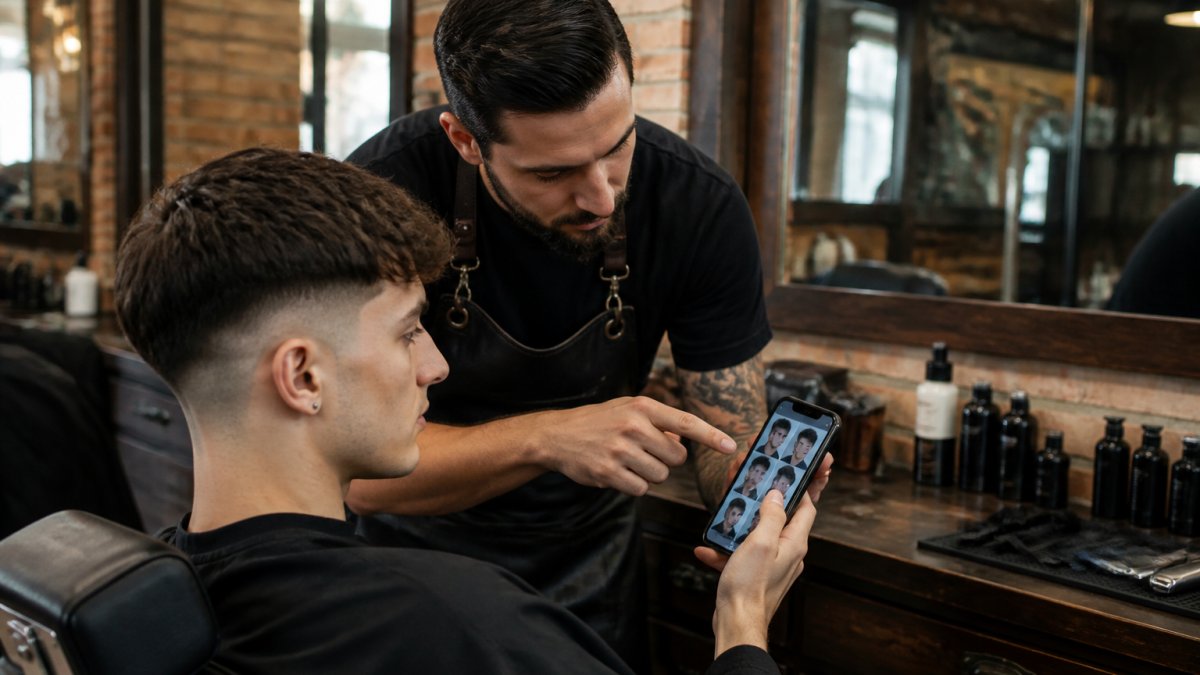
Here's a script you can use word for word:
"I want a [style name] with about [length] left on top and a [number] guard on the sides. Please keep the natural shape of my hairline and taper the neckline. Here are two photos of what I mean. My hair tends to [frizz/lay flat/get oily], so keep that in mind. How would you adjust this for my hair type?"
That last question matters. It invites the barber's expertise instead of locking them into a request that won't work on your head.
The Consultation Checklist You Can Reuse Every Visit
Before you sit down, run through these five points. They cover everything a barber needs to give you a cut that fits.
- Length on top: State it in inches or finger-widths, not words like "short." "Two inches on top" is clearer than "a little off."
- Sides and back: Give a guard number (1-4 is common for fades) or a clipper-over-comb preference. If you want a taper, say where it starts.
- Neckline: Choose between a round neckline (natural, softer) or a squared neckline (sharper, more structured). Say which you want.
- Hairline: Ask to keep the natural shape unless you want a sharp line-up. A line-up every visit can push your hairline back over time, so many barbers recommend alternating.
- Texture and styling: Tell them how you wear it daily. If you air-dry and go, say so. If you blow-dry and use paste, say that too.
Bring Reference Photos, Not Just Words
Photos beat descriptions every time. Words like "short" mean different things to different people.
- Bring two or three photos, not one
- Include one photo of your own hair looking its best
- Point to the exact part of the photo you like
Match the Cut to Your Face Shape, Hair Type, and Lifestyle
A great haircut fits your face and routine, not just a trend. Use this quick guide before you book.
Face shape:
- Round: Ask for height on top and tighter sides to add angles. Avoid heavy fringes that widen the face.
- Square: Most styles work. Soften the corners with a slight taper if you want less edge.
- Oval: Nearly anything works. Use the cut to express your style, not to correct proportions.
Hair type:
- Fine, straight: Shorter, layered cuts look fuller. Heavy product flattens fine hair fast.
- Thick, straight: Needs regular thinning and texturizing or it grows out bulky.
- Wavy: Works with almost any length. Ask for a cut that follows the natural wave instead of fighting it.
Lifestyle:
- If you won't style it daily, ask for a cut that works with little effort
- If you work out often, ask for a cut that holds shape after sweat and a rinse
- If you wear hats, mention it so the barber adjusts the crown
Growth pattern: Cowlicks and swirls change how a cut falls. Point them out before the cape goes on.
What to Expect During the Appointment
A standard appointment runs 30 to 45 minutes and follows a predictable flow. Knowing the steps helps you speak up at the right moment.
- Consultation: You talk through the style and confirm length
- Prep: Cape on, neck strip in place, hair dampened if needed
- Sectioning: The barber divides hair to work in clean sections
- Cutting: Clippers, shears, or both, depending on the style
- Detailing: Hairline, edges, and neckline get cleaned up
- Check: The barber shows you the back with a mirror
- Finish: Product goes in and the cape comes off
Speak up during the cut, not after. If the sides look shorter than you wanted, say so while the barber can still adjust.
How to Style Men's Hair Professionally at Home
Professional styling at home comes down to three moves: dry your hair right, use a small amount of product, and build the shape with your hands or a brush.
For a polished, high-shine finish, we make our Sleek Hair Paste, a water-based paste with an 8/10 hold that works on all hair types.

- Use a dime-sized amount for short hair, a bit more for longer styles
- Rub it in fully before it touches your hair
- Build in layers instead of dumping it all in at once
For humidity-resistant hold on thick hair, a paste with real staying power can be more effective than a lightweight cream.
Professional Haircut Maintenance Between Visits
A sharp cut starts fading around week three. A few habits keep it fresh until your next appointment and preserve the shape longer.
How Often to Get a Trim
Trim frequency depends on how tight the style is and how fast your hair grows. Hair grows roughly half an inch per month on average, so use that as your baseline.
- Skin fade or tight taper: Every 2 to 3 weeks to keep the blend clean
- Classic taper or short sides: Every 3 to 4 weeks
- Medium-length styles: Every 4 to 6 weeks
If you're unsure, ask your barber for a rebook window before you leave; most shops will book your next appointment at checkout.
Daily and Weekly Aftercare Routine
- Wash with a gentle shampoo two to three times a week to avoid stripping natural oils
- Condition every wash to keep hair soft and easier to shape
- Rinse with cool water at the end of a shower to help seal the cuticle and reduce frizz
Product Use by Hair Type
How much product you use matters as much as which product you use.
- Fine hair: A dime-sized amount of a lightweight paste or cream. Too much flattens the cut.
- Medium hair: A dime to nickel-sized amount of paste or pomade, applied in layers.
- Thick or curly hair: A nickel-sized amount of a heavier paste or cream, worked in from back to front.
Apply to damp or dry hair depending on the product. Water-based products rinse clean; oil-based ones need a stronger shampoo.
Neckline and Edge Touch-Ups
A clean neckline is the fastest way to look freshly cut. If you touch it up at home:
- Use a trimmer with a guard, not a bare blade
- Work in short, upward strokes against the grain
- Follow the existing line instead of creating a new one
When to Book Your Next Appointment
Book before you leave the shop, that habit keeps you on schedule and locks in your preferred barber and time slot. If you can't commit to a date, set a phone reminder for the week your cut usually starts to lose shape.
Common Mistakes, Pricing, Tipping, and Fixing a Bad Cut
Most bad haircuts trace back to vague requests, not bad barbers. Fix the ask and you fix the result.
The most common mistakes we see:
- Saying "the usual" when you actually want a change
- Skipping photos and hoping for the best
- Waiting too long between cuts
Haircut costs vary widely by shop and region, so ask when you book rather than guessing.
If a cut misses the mark, call the shop. Most barbers will fix it at no charge within a few days. Be specific about what's off, and bring a photo if you can.
Conclusion: Your Next Steps to a Sharper Barber Look
Getting a professional barber look comes down to choosing well, communicating clearly, and maintaining what you paid for.
Gentlemen Republic makes professional-grade grooming products rooted in real barbering experience, from our Sleek Hair Paste to our Precision Pro Trimmer with zero-gap blades and two-hour runtime.

Shop with Gentlemen Republic and get a look that holds up from the chair to the end of the day.
Frequently Asked Questions
What should I tell my barber to get the haircut I want?
Bring two or three reference photos that show the front, side, and back of the style. Name the clipper guard numbers used on the sides and back, and state how much length you want off the top. Mention your routine: how often you wash, whether you use product, and how much time you'll spend styling. A barber look comes from a cut that fits your hair type, face shape, and daily habits, so share those details during the consultation before the first cut.
How often should I get a haircut to keep a professional barber look?
Most men need a trim every three to four weeks to keep edges, neckline, and shape sharp. Short fades and close crops show regrowth fastest, so some schedules run every two weeks. Longer styles can stretch to six or eight weeks with regular washing, conditioning, and light trimming at home. Book your next appointment before you leave the chair, and ask your barber which products will hold the style between visits.
What percent tip should I give a barber?
Standard tipping runs 15 to 20 percent of the service total, with 20 percent common for a cut you're happy with. Add more for extra time, detailed work, or a beard trim bundled into the visit. Cash is still appreciated, though card and app tips are normal now. If a shop owner cuts your hair, tipping is optional but never wrong. Budget the tip into your total cost before you book so the final price doesn't surprise you.
What tools and products help maintain a professional barber look?
You need a clipper for bulk work, a trimmer for edges and neckline, a comb, and a styling product matched to your finish. The Gentlemen Republic Essence Professional Clipper ($200) runs a 10,000 RPM motor with DLC blades, and the Precision Pro Trimmer ($125) handles zero-gap detailing. For hold with shine, Sleek Hair Paste ($22) works on all hair types. Wash, condition, and dry your hair properly before styling so the product sits evenly.

Share:
Best Men's Hair Styling Guide 2026: Cuts, Products & Routines
Matte Paste vs Pomade for Men: Which to Use in 2026